Category: Music

Albums, sound and other reasons to turn the volume up.

  • A Turntable Setup Without the Audiophile Theatre

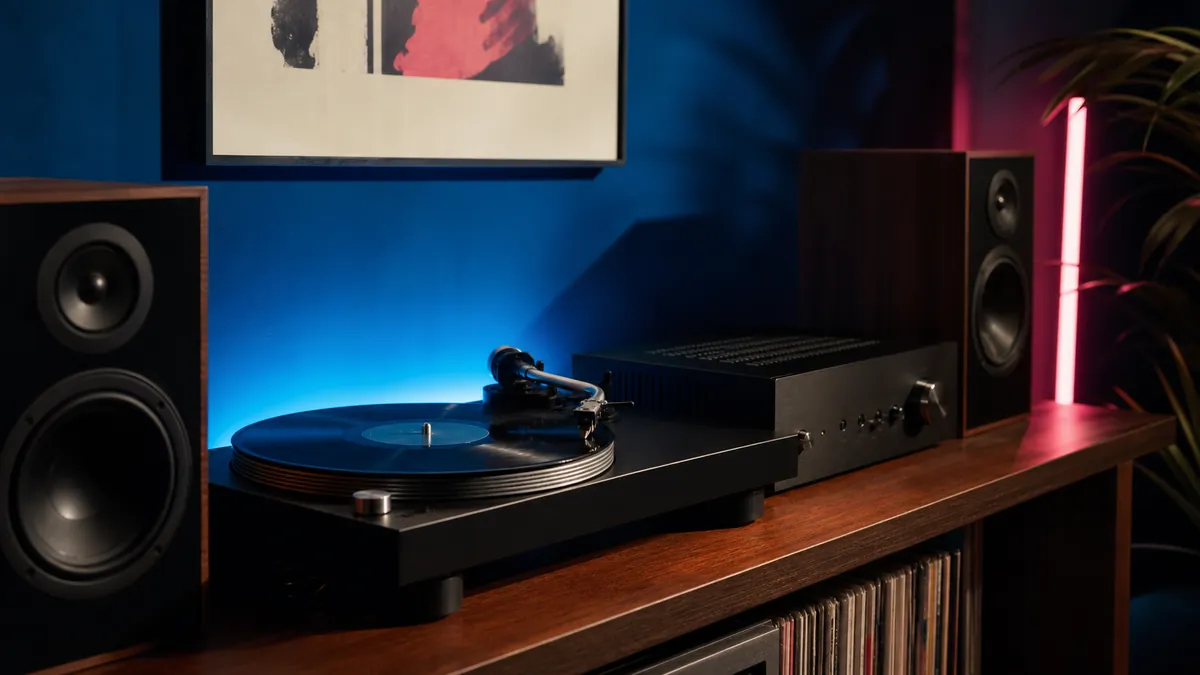
    A straightforward turntable, amplifier and speaker setup in a warm room

    Vinyl invites ritual, and ritual attracts theatre. Soon a simple record player is surrounded by arguments about exotic cables, impossible-to-measure improvements and accessories that cost more than the records. A satisfying setup is much simpler: stable furniture, correct geometry, clean records and speakers placed with some thought.

    Start level and stable

    A turntable works by tracing microscopic movement. Put it on a rigid, level surface that does not wobble when someone walks past. Keep it away from speakers and resonant hollow furniture. In difficult rooms, a properly installed wall shelf can solve more problems than an expensive cartridge.

    Set the basics correctly

    Balance the tonearm, apply the recommended tracking force and set anti-skate according to the manufacturer’s guidance. Confirm cartridge alignment with an appropriate protractor. These ordinary adjustments protect records and improve sound more reliably than decorative upgrades.

    Understand the signal path

    A phono cartridge produces a small signal that requires phono amplification. That stage may be built into the turntable, amplifier or a separate box. Use only one phono stage in the chain. Connecting a phono-level signal to the wrong input produces either a whisper or a distorted mess.

    Clean records beat expensive mythology

    Dust and static are audible. Use a sensible brush, store records vertically in clean inner sleeves and deep-clean second-hand finds when needed. Replace a worn stylus on schedule. Maintenance is less glamorous than shopping, which is why it works so well.

    Place the speakers

    Speaker position and listening geometry shape the result enormously. Give speakers space from boundaries where possible, aim them consistently and avoid placing the turntable directly in their vibration field.

    Then stop adjusting and play a record. The system exists for music, not for becoming a permanent engineering project with a soundtrack.

  • Madonna’s Confessions II: The Dance Floor Is Sacred Again

    Madonna’s Confessions II: The Dance Floor Is Sacred Again

    A futuristic violet dance floor under a mirrored disco ball

    Some records arrive politely. Confessions II kicks open the club doors in a cloud of violet light and demands that everybody move.

    Released on 3 July 2026 through Warner Records, Madonna’s fifteenth studio album is a spiritual sequel to 2005’s Confessions on a Dance Floor. More importantly, it reunites her with producer Stuart Price—and that reunion feels less like nostalgia than unfinished business.

    The original Confessions treated the album as one long night out: seamless, euphoric and just melancholic enough to keep the glitter from becoming empty decoration. Its successor understands the same essential truth. Great dance music is not background noise. It is architecture for bodies, memories and reinvention.

    Back under the mirror ball

    The opening track, “I Feel So Free,” sets out the record’s intentions immediately. Synths rise and circle; the beat moves with purpose; Madonna sounds as if she has rediscovered a room she never truly left. The continuous flow gives the album a wonderfully old-fashioned confidence: this is something to play from beginning to end, preferably loudly and after dark.

    The official release came in an almost comical number of editions—standard and deluxe vinyl, CDs, cassette, digital versions, instrumentals and several special editions. Normally that might feel excessive. For Madonna, excess is part of the grammar.

    Why it works

    What makes Confessions II fantastic is not simply that it resembles a beloved record. It remembers why the original worked. The dance floor can hold pleasure and grief at the same time. Repetition becomes ritual. A bassline can be both ridiculous and profound.

    Twenty-one years later, Madonna is not pretending that time stood still. She is using the club as a place where time briefly stops mattering. That is a much more interesting proposition—and a very Madonna one.

    Verdict: Put away the tasteful playlist. Turn off shuffle. Let the whole thing run.

    Sources: Madonna’s official announcement and official album formats. Header artwork is an original editorial illustration.