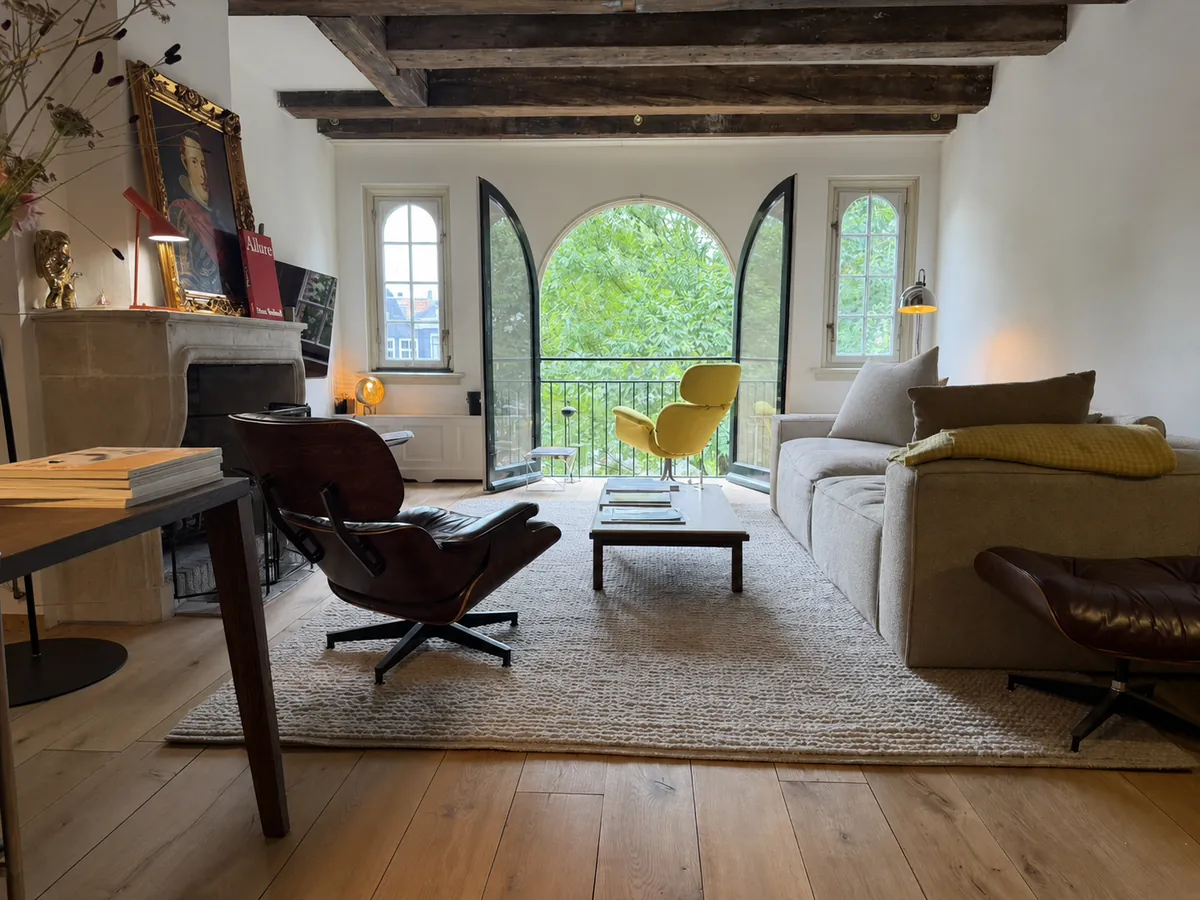
The yellow chair by the open window looks cheerful. Underneath, it is doing serious engineering. Vitra’s Grand Repos, designed by Antonio Citterio in 2011, is a contemporary wing chair built around movement: it supports the body from upright conversation to fully reclined retreat without advertising the mechanism that makes it possible.
A wing chair without nostalgia
The high back and projecting head section connect Grand Repos to the traditional wing chair, but Citterio removes the historical decoration. The volumes are broad and protective; the seams give the upholstery just enough structure; the swivel base keeps the object visually lighter than its comfort suggests.
The result feels architectural. It creates a room within the room, especially when placed near a window or away from a wall. From behind, the chair reads as a single strong silhouette. From the seat, the wings reduce peripheral distraction and make reading or listening feel private.
The hidden mechanism
Vitra describes a synchronised mechanism concealed beneath the upholstery. Backrest and seat respond together as the sitter changes position, and the chair can be locked at different reclining angles. Resistance can be adjusted to suit the user’s weight.
This is the opposite philosophy from a visibly mechanical office chair. Grand Repos hides the technology so that comfort feels intuitive. The lever is present, but the chair never looks like equipment.
Why yellow changes everything
In a neutral fabric, Grand Repos can behave as quiet background architecture. Yellow turns its protective form into something optimistic. Against green trees outside the window, the chair becomes almost graphic—a warm shape floating between the pale room and the view.
It also prevents the interior’s celebrated classics from becoming too reverent. A burgundy Eames Lounge Chair is dark, grounded and materially rich. Grand Repos is bright, upright and visually buoyant. Their disagreement is what makes the pairing work.
A room becomes personal when excellent objects are allowed to argue with one another.
Contemporary comfort among older icons
Grand Repos is decades younger than the Eames Lounge Chair and Cees Braakman’s Pastoe seating. It does not need to imitate either. Instead, it demonstrates how the lounge-chair problem evolved: the fixed geometry of mid-century design gives way to adjustable support, removable upholstery and a mechanism engineered around different bodies and postures.
The chair earns its place not because it is collectible, but because it is used. It faces the view, catches the changing daylight and offers the most naturally private seat in an otherwise open room.
Model information: Vitra Grand Repos — Antonio Citterio, 2011.
Leave a Reply