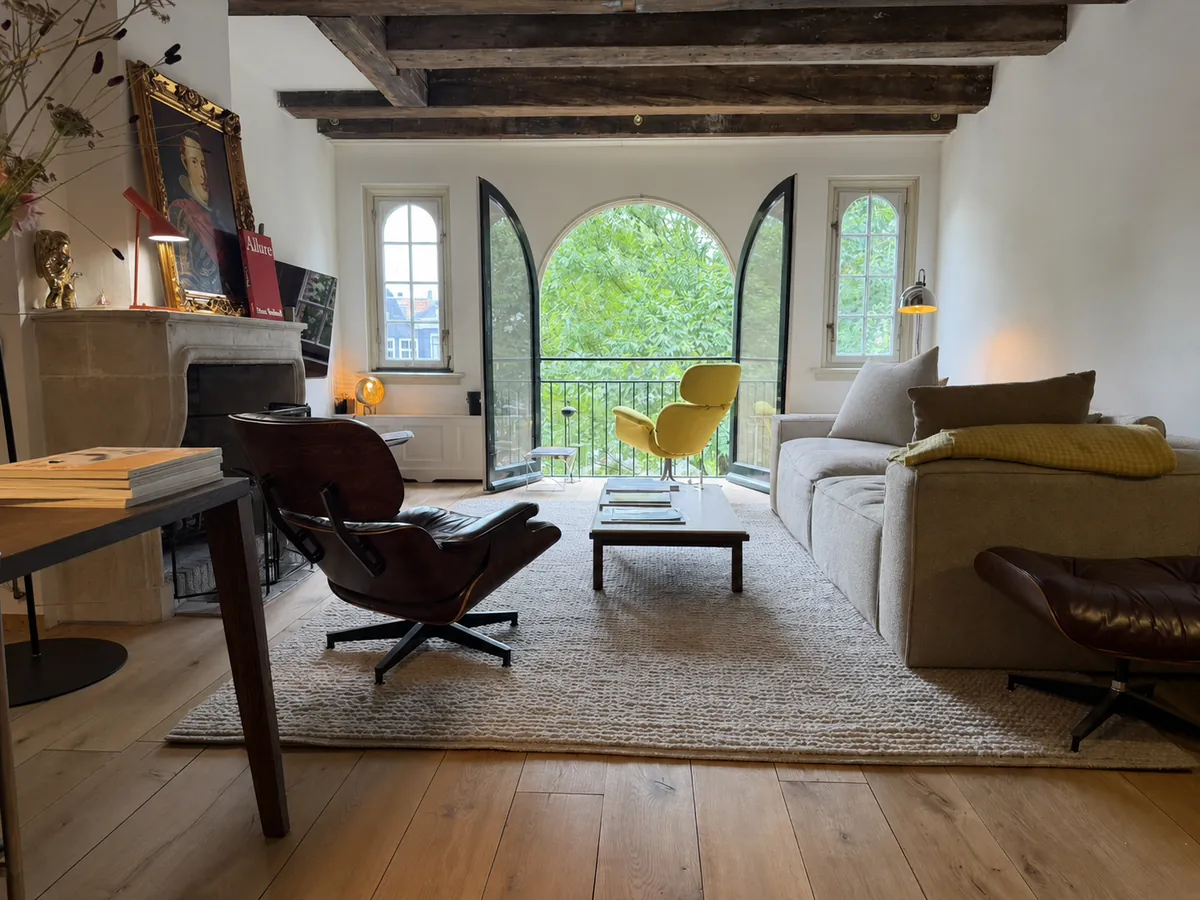
A burgundy Eames Lounge Chair does not disappear into a room—and it should not. The deep leather, curved wooden shells and black aluminium base create a silhouette that is generous without becoming bulky. It is an icon, certainly, but the real pleasure begins when it stops behaving like museum furniture and becomes part of everyday life.
The chair that changed the idea of modern comfort
Charles and Ray Eames introduced the Lounge Chair and Ottoman in 1956. Instead of the visual austerity associated with much early modern furniture, it offered softness, warmth and the relaxed character of a well-used club chair—reinterpreted through moulded plywood and industrial production.
Vitra has produced the chair in Europe since the 1950s using methods that remain close to the original. The relationship between the three curved shells and loose cushions is the essential idea: structure and softness remain visibly separate, which keeps the chair from looking heavy.
Why burgundy is better than safe black
Black leather is canonical. Burgundy is personal. It brings out the reddish warmth in the wood veneer and changes throughout the day, moving from near-brown in shadow to wine-red in direct light. Marks and creases become part of that colour rather than flaws to be corrected.
The chair works especially well among old beams, stone, books and imperfect materials. Its precision gives the room structure; the leather prevents that precision from feeling cold.
The best original design is not protected from life. It becomes better evidence of it.
Across the room: Grand Repos in yellow
The yellow chair in the background is not another Eames. It is Vitra’s Grand Repos, designed by Antonio Citterio in 2011. Its concealed synchronised mechanism allows the backrest to recline and lock at different angles. Where the Eames Lounge Chair makes its construction visible, Grand Repos hides the engineering inside generous upholstery.
The combination is more interesting than a matching pair. Burgundy and yellow create tension; American mid-century optimism meets contemporary Italian precision; one chair cradles through fixed geometry while the other moves with the sitter.
The quieter counterpoint: Cees Braakman’s SM07
Elsewhere in the interior, the black dining chairs appear to be the SM07 designed by Dutch modernist Cees Braakman for UMS Pastoe’s Japanese Series around the turn of the 1960s. Their slender chromed-steel frames and black upholstery use almost nothing to describe a chair.
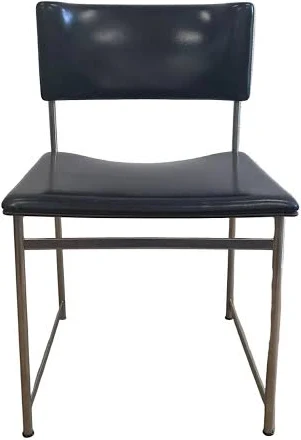
Braakman’s restraint is the necessary counterweight to the lounge chairs. The SM07 does not compete for attention. Its thin rectangular frame allows architecture and people to remain visible through it. That visual economy is why a sixty-year-old dining chair can still feel current.
An interior built through contrast
Good rooms rarely come from buying a complete collection at once. They grow through differences: sculptural lighting against old stone, a technically complex recliner beside a 1950s icon, and minimal Dutch dining chairs holding the composition together.
The Eames remains the emotional centre—not because it is famous, but because burgundy leather gives a highly recognisable object a specific life and place.
Further reading: Vitra Lounge Chair and Vitra Grand Repos.
Leave a Reply